Main Calculator
Measure the room once, then use the same estimate across the full drywall package
The sheets tab drives the rest of the workflow. After you size the room, the other tabs stay synced so you can price materials, estimate mud and screws, and check total carrying weight without re-entering everything.
Calculator Panel
Drywall room calculator
Switch tabs at any time. Your sheet count stays linked to the other estimate modules.
Each door deducts 21 sq ft.
Each window deducts 15 sq ft.
Most rooms work well with 10% to 12% waste.
Recommended purchase rounds up to the next two-sheet bundle so you have spare material for bad cuts and future repairs.
Quick presets
Start with common room sizes
Tap a preset to preload room dimensions into the sheets calculator. Values convert automatically when you switch between feet and meters.
How to use this drywall calculator
Measure once, estimate the full drywall package, then buy with confidence
The fastest way to use a drywall calculator is to think like an estimator, not just like a shopper. Start with the room envelope, decide whether the ceiling is part of the scope, and then translate that surface area into sheets, finishing materials, and jobsite handling needs. This page is built so you can move from rough takeoff to material planning without opening a second tool.
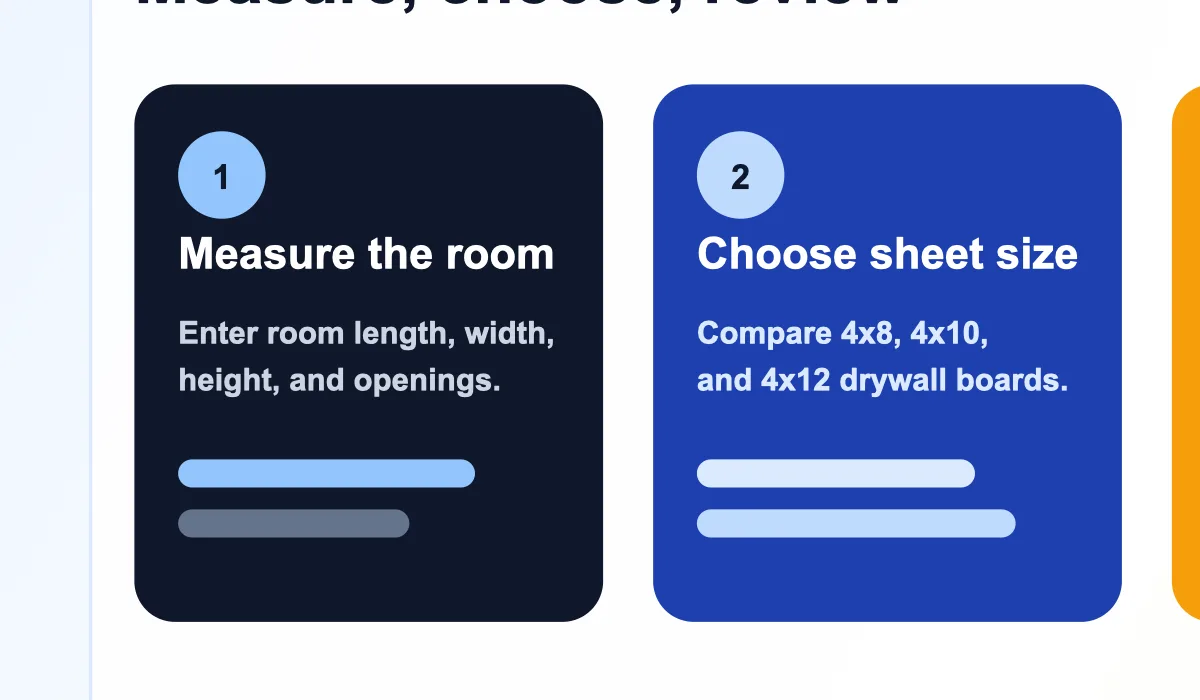
Enter dimensions
Add room length, width, and ceiling height. If you are boarding the ceiling, turn that option on so ceiling area is included in your drywall sheet calculator result.
Choose the board strategy
Pick 4x8, 4x9, 4x10, or 4x12 drywall and set a waste factor based on layout complexity. Larger boards reduce seams, but they are harder to move and hang.
Use the linked calculators
The other tabs reuse your sheet count so you can estimate drywall cost, joint compound, screws, and total weight. Print or copy the summary for the supply yard.
When people search for a drywall calculator, they usually want one answer: how much drywall should I buy? In practice, a useful estimate needs more context. The cheapest mistake in drywall is often ordering an extra sheet. The expensive mistakes are underestimating labor, running out of mud halfway through finishing, or loading so much board into a pickup that the trip becomes unsafe. That is why this tool keeps sheets, cost, mud, screws, and weight together on one page. Use the summary as a planning estimate, then confirm framing layout, specialty board requirements, and local pricing before placing the final order.
How many sheets of drywall do I need
12x12 room: how many sheets of drywall do I need?
A standard drywall sheet calculator starts with total surface area. For walls, multiply the room perimeter by ceiling height. If the ceiling is being finished too, multiply room length by room width and add that number to the wall area. From there, subtract openings such as doors and windows. Finally, divide the adjusted area by the square footage covered by one sheet and add a waste factor.
Total sheets = ((wall area + ceiling area - openings) x (1 + waste factor)) / sheet area
For a 12x12 room with 8 foot ceilings, the wall perimeter is 48 feet. Multiply that by 8 feet and you get 384 square feet of wall area. If you also include the ceiling, that adds another 144 square feet for a total of 528 square feet. Subtract one door and one window and the working area drops to 492 square feet. Divide by 32 square feet for a 4x8 sheet and you land just over 15 sheets. Add 10 percent waste and you are in the 17 sheet range, which is why many people searching for "12x12 room how many sheets of drywall" end up buying 17 or 18 sheets depending on openings and cut layout.
Waste matters because drywall is not installed as perfect rectangles on a spreadsheet. You will cut around receptacles, doors, windows, soffits, plumbing penetrations, and ceiling fixtures. Edge damage during delivery and handling also eats into usable material. For clean rectangular rooms, 10 percent waste is a reasonable default. If the room has many corners, a sloped ceiling, or several built-ins, pushing the waste factor closer to 15 percent is safer.
Board orientation changes yield as well. Hanging drywall horizontally on walls can reduce seam count, especially in rooms with 8 or 9 foot ceilings, but it can also create longer offcuts. In basements and garages, larger sheets sometimes lower both seam count and waste. In bathrooms and tight remodels, smaller boards can be easier to maneuver, which reduces breakage and bad cuts even if seam count goes up a little.
Drywall sheet calculator inputs
Drywall sheet calculator and sheet sizes guide
Sheet size directly affects seam count, labor speed, waste, handling difficulty, and the number of screws you need. The best board is not always the largest one.
| Sheet size | Coverage | Best use | Main tradeoff |
|---|---|---|---|
| 4 x 8 | 32 sq ft | Small rooms, remodels, DIY work | More seams on long walls |
| 4 x 9 | 36 sq ft | 9 ft ceilings and stairwells | Less common stock item |
| 4 x 10 | 40 sq ft | Long walls, medium ceilings | Heavier to move and lift |
| 4 x 12 | 48 sq ft | Open rooms and large ceilings | High weight and awkward handling |
If you are working alone or carrying sheets through finished spaces, 4x8 drywall is often the smart choice even when longer sheets look cheaper on paper. Fewer broken corners and less wrestling with material can erase the theoretical seam savings of a 12 foot board. On the other hand, crews hanging drywall in open-plan rooms often prefer 4x10 or 4x12 sheets because labor savings can outweigh the added board cost.
Use the sheet size selector in this drywall sheet calculator to compare coverage and to see how that choice cascades into screw counts and carrying weight. A material plan is only good if it still makes sense when the truck arrives and the boards have to move from curb to room.
Board selection
Types of drywall
Not every room needs the same board. Standard drywall is the baseline for most interior walls and ceilings, but moisture, fire separation, and sound control can change the spec. Choosing the right board type early helps you budget accurately because specialty panels usually cost more and often weigh more too.
| Type | Where it fits | Why people choose it |
|---|---|---|
| Standard 1/2" | Bedrooms, living rooms, halls | Lowest cost and easy availability |
| Moisture-resistant | Bathrooms, laundry rooms, utility areas | Better humidity tolerance than standard board |
| Fire-rated Type X | Garages, shared walls, code-required assemblies | Added fire resistance and stiffness |
| Soundproof assemblies | Media rooms, duplex walls, offices | Improved acoustic performance with layered systems |
Moisture-resistant drywall is not a substitute for proper tile backer in direct wet areas, but it is a practical upgrade in bathrooms and laundry spaces where humidity is higher than normal. Fire-rated drywall is heavier and less forgiving to cut, yet it is essential when the wall assembly needs to meet code. Soundproofing often depends on the whole assembly, including insulation, resilient channel, sealant, and sometimes double layers, so board type alone rarely tells the full story.
This calculator includes the most common weight profiles for standard, lightweight, fire-rated, and moisture-resistant board. That means you can compare not only the cost difference but also the hauling and carrying impact before you decide.
Drywall cost calculator
Drywall cost calculator and material pricing in 2025
Material prices shift by region, by supplier, and by board type, which is why a drywall cost calculator should be adjustable. In many U.S. markets, a basic 1/2 inch 4x8 sheet sits somewhere around the low-teens to high-teens range in 2025, while moisture-resistant and fire-rated products cost more. Longer boards can look like a better deal per square foot, but delivery fees and crew requirements can change the true cost.
Labor is often the bigger variable. Hanging, taping, finishing, sanding, and cleanup can easily add more than the sheet price itself. On straightforward residential work, installers often think in cost per square foot because it accounts for room size and scope more consistently than price per board. That is why this calculator lets you apply a labor rate to the measured area while still keeping sheet pricing separate.
A useful drywall cost estimate should include a few reality checks. Does the room have a high ceiling? Are there multiple returns, niches, or soffits? Is there enough access for 12 foot sheets, or will smaller boards reduce damage and labor? Are you comparing store pickup against delivered price? Each of those questions can shift the final project total far more than a small difference in sticker price per sheet.
To save money, plan layouts before you buy. Align sheet length with wall or ceiling span where possible, keep waste near 10 percent instead of 15 percent, and use the summary card to compare alternate board sizes. The cheapest job is usually the one that avoids a second material run and minimizes finishing work.
Drywall mud calculator
Drywall mud calculator: joint compound, tape, and corner bead planning
Once the drywall is hung, finishing materials determine how smooth the project feels on site. A drywall mud calculator helps you avoid the common problem of buying just enough sheets but not enough compound, tape, or corner bead to finish the job. This tool uses a simple planning rule of about 0.053 five gallon buckets of joint compound per sheet per coat. With three coats, that becomes about 0.159 buckets per sheet.
Tape needs vary with layout, but a practical estimate is to keep a generous allowance so long joints, butt seams, and repairs do not catch you short. Corner bead is even more project-specific because outside corners depend on room geometry. That is why the calculator lets you toggle corner bead on only when you need it and enter the total linear footage directly.
Finish level matters too. A garage or utility space may only need a basic taped and finished surface. A bright living room with large windows will reveal every seam and sanding mark, so material use and labor time usually rise. If you know the walls will receive glossy paint, err on the side of more finishing time and a cleaner material buffer.
Drywall screw calculator
Drywall screw calculator: how many screws per sheet of drywall?
Screw count depends on sheet size, framing layout, and whether the board is installed on walls or ceilings. A familiar rule of thumb is about 32 screws for a 4x8 sheet on studs spaced 16 inches on center. Wider 24 inch spacing reduces that count slightly, while longer sheets increase it because more surface area needs fastening.
It is smart to add a waste factor to fasteners too. Screws get dropped, stripped, overdriven, and mixed with the wrong length on real jobsites. This drywall screw calculator adds a 10 percent allowance and converts the result into one-pound box estimates based on roughly 200 screws per box.
If you are boarding ceilings, use the screw count as a planning number rather than a code reference. Always follow the board manufacturer, local code, and project engineer where applicable, especially on fire-rated or commercial assemblies.
Drywall weight calculator
Drywall weight calculator for delivery planning
A drywall weight calculator is essential whenever you are using long sheets, specialty board, or your own vehicle for pickup. A standard 1/2 inch 4x8 sheet is often around 57 pounds, while a fire-rated 5/8 inch 4x12 sheet can reach about 105 pounds. Multiply that by a full room order and the load adds up quickly.
Weight is not only a transport issue. It affects how many people are needed to carry material safely, whether a drywall lift makes sense for ceilings, and how much effort is required to move boards through tight stairways or finished interiors. Lightweight board can reduce fatigue and speed up handling, but it may cost more depending on your market.
Use the weight result as a safety prompt. Many standard pickups are in the neighborhood of a 1000 pound payload once passengers and tools are included. If your order climbs beyond that, delivery or a trailer may be the sensible choice.
Drywall ceiling calculator
Drywall ceiling calculator: how to calculate drywall for a ceiling
Ceiling drywall is simple to estimate but easy to overlook. Multiply room length by room width to get ceiling area, then divide by your chosen sheet coverage. The catch is handling. Ceiling work usually favors fewer seams, which makes longer sheets attractive, but it also makes lifting and alignment harder. On open ceilings, 4x12 sheets can be a labor saver. In small homes and occupied remodels, 4x8 sheets may still be the better total job decision.
If the ceiling has recessed lights, attic accesses, or beams, keep the waste factor a little higher than you would for a blank rectangle. Small penetrations turn big offcuts into scrap quickly.
Pro tips
Reduce waste and buy the right amount the first time
- Match sheet length to wall span when possible so fewer butt joints need finishing.
- Stage boards close to the work area before hanging to avoid corner damage during repeated moves.
- Buy a small buffer above your waste factor if you are using specialty board that is harder to source quickly.
- Track ceiling, walls, and bulkheads separately on complex jobs so one awkward area does not distort the whole estimate.
- Think about carrying weight before you upgrade to longer sheets. Labor savings disappear fast if access is poor.
- Use the copy and print tools to compare supplier quotes without re-entering all project data.
The best drywall calculator is the one that helps you make better decisions before the truck leaves the yard. Fast estimates are useful, but realistic estimates are what save money. Plan for waste, choose a board size your crew can actually handle, and let the linked cost, mud, screw, and weight outputs tell you whether the job still makes sense after the sheet count is done.
Tool Matrix
Expand beyond the main calculator
Use the main estimator for quick planning, then move into dedicated calculators for room pricing, waste, ceilings, mud, weight, paint, framing, and cost per square foot.
Room Cost Estimator
Turn room dimensions into a full drywall estimate with labor, tax, and price ranges.
PopularDrywall Waste Calculator
Adjust waste by room complexity and installer experience before you buy extra sheets.
PopularDrywall Mud Calculator
Estimate compound, tape, primer, and finish coat needs in one focused calculator.
Drywall Weight Calculator
Check board weight, truck load planning, and handling before delivery day.
View all drywall calculators to cover estimating, buying, hauling, and finishing.
View all drywall calculatorsGuides & Articles
Read the supporting guides before you order
The calculator gets you to a number. The guides explain why that number changes when board type, finish level, layout, and labor strategy change.
How Much Drywall Do I Need?
Examples, formulas, and waste rules for common room sizes and ceiling layouts.
Drywall Cost Guide 2026
Break down sheet pricing, installed cost, finish levels, regional differences, and DIY savings.
How to Tape Drywall
Learn the three-coat sequence, tape choice, corners, sanding flow, and how to avoid visible seams.
Read our drywall guides for installation, cost planning, materials, and finishing.
Read our drywall guidesFAQ
Drywall calculator questions
For a 12x12 room with 8 foot ceilings, wall area is about 384 square feet. If you include the ceiling, total coverage is about 528 square feet before subtracting openings. With one door, one window, and 10 percent waste, many projects land around 17 sheets of 4x8 drywall.
Multiply room length by room width to get ceiling area. Then divide by the square footage covered by your chosen sheet size and add waste for light cutouts and layout.
4x8 sheets are easiest for DIY handling and tight spaces. 4x10 and 4x12 sheets reduce seams on large walls and ceilings but require more carrying strength and more room to maneuver.
In many areas, common 1/2 inch drywall lands roughly in the $12 to $20 range per sheet in 2025, with specialty boards priced higher. Local supply, delivery, and board thickness can move that range up or down.
A practical estimate is around 0.053 five gallon buckets per sheet per coat. Three coats work out to roughly 0.159 buckets per sheet, depending on finish quality and repairs.
A 4x8 sheet on 16 inch on-center framing often uses about 32 screws. Longer sheets or ceiling work increase the total, so it makes sense to add a fastener buffer.
Yes. Waste covers damage, bad cuts, odd layouts, and a small repair reserve. Ten percent is a common starting point for clean residential rooms.
Half inch drywall is the standard choice for most walls. Five eighths inch drywall is heavier, stiffer, and commonly used where fire rating or ceiling sag resistance is more important.
A standard 1/2 inch 4x8 sheet is often around 57 pounds, while lightweight versions are closer to 44 pounds. Fire-rated sheets can be much heavier, especially in 10 or 12 foot lengths.
Yes, but treat it as an estimating aid. Commercial jobs may require code-specific assemblies, special framing layouts, and product submittals that change final material counts.
Planning notes
Use the right drywall calculator for each planning decision
A good drywall sheet calculator gets you the sheet count, but a real project usually needs a few related checks before you place the order. If you are pricing a remodel, use the drywall room cost estimator or the drywall cost per square foot calculator to compare material and labor scenarios. If the room has complex cuts, soffits, or angled ceilings, run the same scope through the drywall waste calculator and the ceiling drywall calculator so you do not underbuy.
Finishing matters too. After you answer "how much drywall do I need," the next jobsite question is usually how much mud, tape, and handling capacity the project requires. The drywall mud calculator helps plan compound by coat count, while the drywall weight calculator helps you check truck loads, stairs, and carrying strategy before delivery day.
Together, these tools cover the long-tail questions people actually search for: drywall calculator for walls and ceilings, drywall cost estimator, drywall waste calculator, drywall mud calculator, drywall weight calculator, and drywall cost per square foot. Use the calculator on this page for the fast base estimate, then open the linked tools when you need a tighter budget or a more specific material plan.